

Contractors’ Guide to Scaffolding Work at Height Rules
Work at height: Quick answer
Work at height includes any work where a person could fall and suffer injury if suitable precautions are not in place. Under the Work at Height Regulations 2005, contractors must ensure work is properly planned, supervised, carried out by competent people, and supported by suitable equipment. For most construction projects, scaffolding remains one of the safest and most effective ways to comply with these requirements.
Key takeaways
- Work at height is not defined by a specific height.
- Contractors remain legally responsible for managing work at height risks.
- Work at Height Regulations 2005 apply to most construction projects.
- Scaffolding often provides the safest form of collective fall protection.
- Scaffolds must be inspected before first use, every seven days, and after events that could affect safety.
- Competence, planning, inspection, and documentation all form part of compliance.
Work at height compliance checklist
☐ Has a work at height risk assessment been completed?
☐ Has the safest access method been selected?
☐ Are workers competent and appropriately trained?
☐ Has the scaffold been designed correctly?
☐ Have statutory inspections been planned?
☐ Are handover certificates available?
☐ Are inspection records being maintained?
☐ Is responsibility clearly assigned to a competent person?
Frequently asked questions
What counts as work at height?
Any work where a person could fall and suffer injury if precautions were not in place.
Who is responsible for work at height compliance?
The contractor, employer, site manager, or duty holder controlling the work.
What are the Work at Height Regulations 2005?
The main UK regulations governing how work at height must be planned, supervised, and carried out safely.
Do the Work at Height Regulations apply to domestic projects?
Yes. The regulations apply wherever work at height creates a risk of injury, including domestic construction, maintenance, roofing, and property improvement projects.
How often should scaffolding be inspected?
Before first use, every seven days, and after alterations or events that could affect safety.
Is scaffolding safer than ladders?
In many situations, yes. Scaffolding provides collective fall protection, stable working platforms, and safer access.
Can contractors be prosecuted for breaches of the Work at Height Regulations?
Yes. Failure to manage work at height risks can lead to enforcement action, fines, and prosecution.
Construction sites are busy places. Trades overlap, schedules tighten, and teams work under pressure to keep projects moving. In the middle of that pressure, scaffolding work at height rules become one of the biggest safety and compliance risks a contractor faces.
Across the construction industry, work at height is unavoidable. Roofing, façade installation, cladding, maintenance, and structural works all require safe access above ground level. That means scaffolding, mobile platforms, mobile elevating work platforms, roof ladders, and other forms of work equipment.
But these activities sit inside a strict framework of health and safety law.
Understanding the Working at Height Regulations 2005, how scaffolding fits into those rules, and how inspections, training and design standards apply is essential for contractors who want to run safer workplaces and protect their businesses.
This guide breaks down the rules in practical terms so contractors, facilities managers, and building owners understand what compliance actually looks like on real job sites, and how a compliance-first scaffolding partner like PJ Slater can help.
Understanding these requirements doesn’t just help you avoid enforcement action. It helps you choose safer access systems, appoint more competent contractors, and run projects with fewer delays and fewer surprises.
Why Work at Height Rules Matter to Contractors
Construction remains one of the most dangerous sectors in Britain.
According to the Health and Safety Executive, 35 construction workers died in work-related incidents in 2024/25 — the highest fatality total of any industry sector.

Behind every fatality is an investigation, halted construction work, insurance scrutiny, and often legal liability for those responsible.
But contractors don’t just deal with safety consequences. You also face:
- Site shutdowns
- HSE enforcement action
- Increased insurance premiums
- Reputational damage
- Project delays
In this sense, when health and safety law is breached, the financial impact can be significant. Not only are you liable for fines and penalties, you’re also facing delayed projects and a loss of future jobs due to poor reputation.
This is why it’s so important to ensure healthy and safety is a prime concern — especially when working at height.
Most construction deaths involve falls from height
Research from the Health and Safety Executive also shows that across Britain, falls from height remain the leading cause of workplace deaths. They’re responsible for roughly 25–30% of all worker fatalities each year.

On building sites these incidents often occur during or due to:
- Roof work
- Façade installation
- Scaffold access
- Incomplete edge protection
- Poorly installed guard rail systems
In many cases the worker involved was standing on a scaffold platform, using a ladder, or working near a building edge.
This is why the scaffolding industry plays such a critical role in risk prevention.
Well-designed temporary scaffolding, fitted with toe boards, guard rails, and stable scaffold boards, provides a safe work platform that help prevent falls before they happen.
Injuries disrupt projects long before fatalities occur
Fatal incidents are the most serious outcome, but they are not the most common.
According to HSE, every year the UK loses 4.4 million working days due to workplace injury.
For contractors, injuries create operational problems long before regulators get involved.
An injured worker can mean:
- Delayed programme schedules
- Labour shortages
- Increased supervision requirements
- Disrupted subcontractor coordination
In severe cases, injuries can lead to personal injury claims, investigations, and civil litigation.
This is why understanding the legal framework around work at height is so important.
Looking for a compliance-first scaffolder who adheres to all scaffolding work at height rules? Fill in the form below to speak to our specialist team.
How Work at Height Rules Help Contractors Choose the Right Scaffolding Partner
Most contractors never read the Work at Height Regulations cover to cover.
What they do need to understand is what the regulations tell them about competence, planning, supervision, and risk management.
In practice, the regulations provide a useful framework for comparing scaffolding companies before work starts.
A low quote tells you very little about how a scaffolding contractor manages safety. The Work at Height Regulations help you ask better questions.
For example:
- How do you assess work at height risks before work begins?
- How do you determine the safest access solution for a project?
- What qualifications do your scaffolders hold?
- How are scaffold inspections managed and recorded?
- How do you manage scaffold design and design changes?
- What documentation do you provide to support compliance?
- Who is responsible for ongoing inspections during the project?
The answers often reveal more than accreditations, marketing claims, or company brochures.
A scaffolding company like PJS that understands work at height compliance should be able to explain its inspection procedures, competence standards, design process, and documentation requirements clearly and confidently.
This is often where the difference between scaffolding providers becomes apparent.
Some companies focus solely on supplying access. Others build their service around planning, compliance, inspections, competence, and risk management.
For contractors, facilities managers, and principal contractors, that distinction can have a significant impact on project safety, programme certainty, and legal compliance.
What Counts as “Working at Height” Under UK Law
Under UK law, work at height is defined broadly.
According to HSE guidance, work at height means any work where a person could fall and suffer injury if precautions are not taken.
This includes many activities contractors deal with daily.
Examples include:
- Working from scaffolding platforms
- Using mobile towers
- Installing materials from mobile elevated work platforms
- Accessing roofs with roof ladders
- Working from podium steps or mobile platforms
Importantly, working at height is not defined by a specific height. After all, a fall from two metres can still result in serious injury or death.
Because of this, the law focuses on risk prevention, not simply height measurement.
The Working at Height Regulations Contractors Must Follow
The Working at Height Regulations 2005 govern how work at height must be planned and carried out.
The regulations apply across all sectors, but they are particularly important in the construction industry, where elevated work is common.
They place responsibility on employers, contractors, and site managers to ensure work is carried out safely. Ultimately, they place responsibility on you.
Rule 1: Work at height must be properly planned
Planning is the first legal requirement.
Before any elevated work begins, contractors must carry out a risk assessment and prepare suitable method statements.
Planning typically includes:
Source: HSE Annual Report & Accounts 2024/25
- Identifying fall hazards
- Selecting appropriate work equipment
- Choosing suitable fall protection systems
- Coordinating trades working at height
Poor planning often leads to enforcement action. If an accident occurs and there is no documented risk assessment, contractors may struggle to demonstrate compliance with legislative requirements.
When that happens, the consequences can escalate quickly — HSE investigations, project delays, enforcement notices, prosecution, and significant financial penalties.
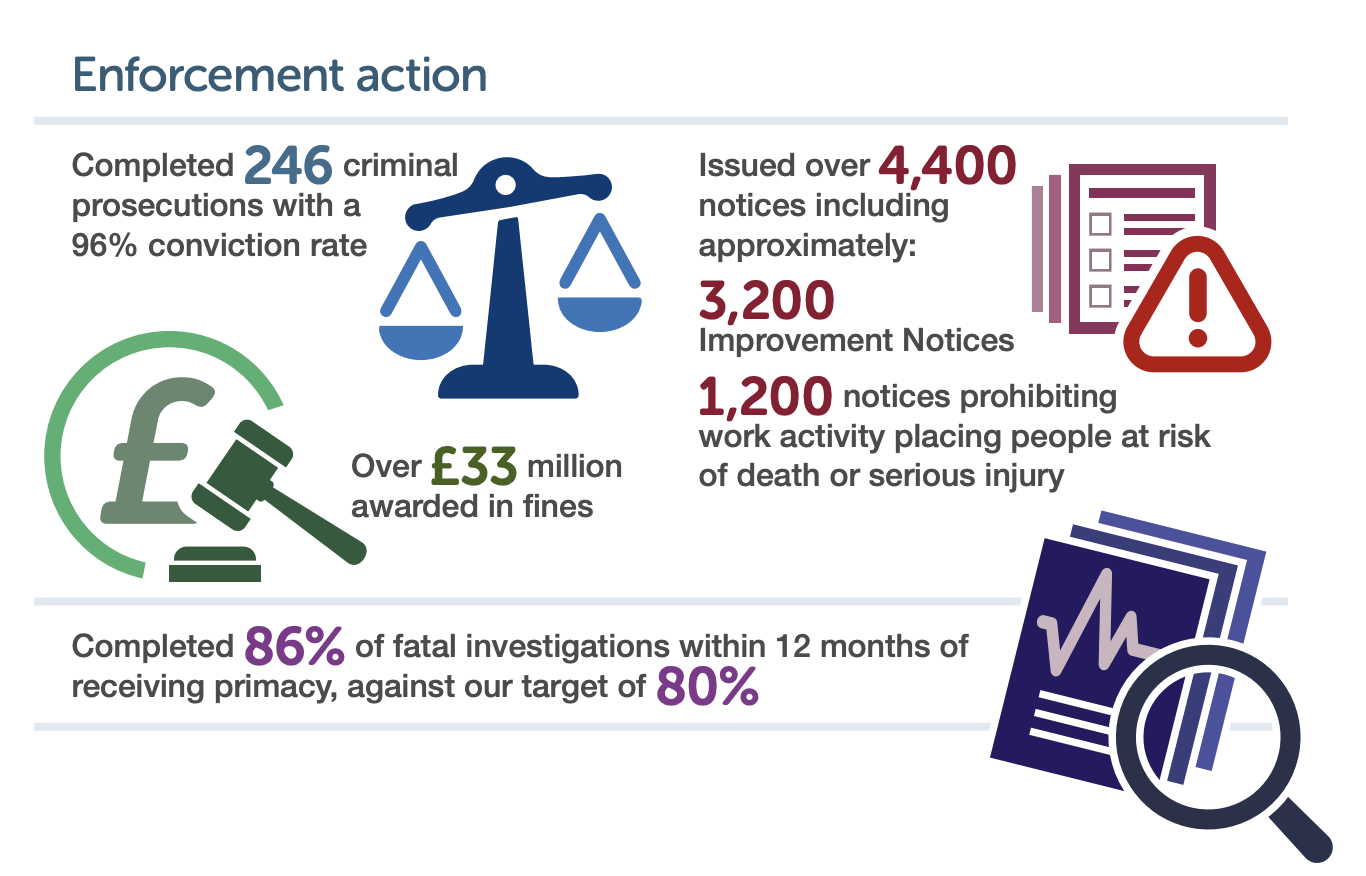
In 2024/25, the Health and Safety Executive prosecuted 246 cases and secured convictions in 96% of them. For contractors, that highlights the importance of being able to demonstrate that work at height was properly planned, supported by suitable equipment, and carried out by competent people.
 Rule 2: The safest access method must be used
The regulations follow a hierarchy of prevention.
Contractors must first try to avoid working at height entirely. When that isn’t possible, they must prevent falls. Only if prevention is impossible should they rely on systems that minimise injury.
The hierarchy typically looks like this:
- Avoid working at height
- Prevent falls with safe access
- Minimise consequences using fall arrest systems
This is why scaffolding often becomes the safest choice. Unlike ladders, scaffolding provides a stable scaffold platform with guard rails, toe boards, edge protection, and safe access.
Safe erection methods are equally important. Across the UK scaffolding industry, NASC SG4 guidance provides the recognised framework for preventing falls during scaffold erection, alteration, and dismantling.
Where scaffolding isn’t practical, contractors may rely on alternatives such as:
- Mobile elevating work platforms
- Cherry pickers
- Cantilevered platforms
Rule 3: Equipment must be suitable and stable

All work equipment used for elevated work must be suitable for the task.
This includes:
- System scaffolding
- Mobile elevated work platforms
- Safety nets
- Fall arrest systems
- Safety harnesses
Equipment must also comply with recognised British standards, European standards, and relevant guidance documents.
For scaffolding structures, design and performance standards such as BS EN 12811-1:2003 apply to ensure safe loading and structural stability.
Rule 4: Work must be properly supervised
Supervision ensures that safety systems remain effective during construction.
Site supervisors must monitor:
- Scaffold integrity
- Worker competence
- Use of safety harness systems
- Installation of edge protection
Workers must also receive appropriate training through recognised industry programmes. In the UK scaffolding sector this typically includes certification through the Construction Industry Scaffolders Record Scheme (CISRS), as well as specialist courses such as NASC SG4 fall protection training, working at height training, and safety harness and fall-arrest training delivered by accredited providers.
Why Scaffolding Plays a Central Role in Work at Height Compliance
In practice, scaffolding often becomes the safest way to comply with work at height rules.
Unlike ladders or temporary platforms, scaffolding provides collective fall protection, meaning it protects multiple workers at once.
A properly installed scaffold system includes:
- Stable scaffold boards
- Toe boards to prevent tools falling
- Perimeter guard rails fitted with brick guards
- Secure ladder access
These features create a controlled work platform that reduces fall risk.
Scaffolding reduces reliance on higher-risk access methods
When scaffolding is used correctly, contractors rely less on high-risk alternatives such as ladders.
This improves safety and productivity at the same time.
Workers can carry materials, install components, and move safely without relying on unstable access equipment.
In some situations scaffolding may also incorporate:
- Safety nets
- Soft landing systems
- Perimeter edge protection
These systems create additional fall protection where needed.
 Scaffold systems must follow recognised design standards
All scaffolding must comply with recognised design guidance.
The National Access & Scaffolding Confederation publishes TG20 compliance sheets, which outline standard scaffold configurations.
When a scaffold falls outside those configurations, a bespoke design must be created.
This ensures the structure can safely support the required scaffold load class, equipment and workforce.
Without proper design documentation, contractors risk installing structures that do not meet regulatory or engineering standards.
This is why it’s so important to choose a scaffolding partner like PJ Slater that offers bespoke design services from a dedicated scaffolding design department with 40+ years experience.
Contractor Responsibilities Under CDM and Work at Height Law
The Construction (Design and Management) Regulations 2015 (CDM) place clear responsibilities on those managing construction projects.
Under CDM, several parties become legal duty holders, including:
- Clients
- Designers
- Principal contractors
- Subcontractors
Each duty holder must cooperate to manage risk and ensure work is carried out safely.
Where scaffolding is involved, that cooperation becomes particularly important.
Access structures interact with multiple trades, changing site conditions, and evolving construction stages. When communication breaks down, risks increase quickly.
Principal contractors must coordinate site safety
The principal contractor is responsible for coordinating safety across the construction site.
Poor coordination increases fall risk and undermines the effectiveness of fall protection systems, particularly when multiple trades are working at height simultaneously.
An experienced compliance-first scaffolding provider helps reduce this risk by communicating clearly with site managers, planning access around programme stages and ensuring scaffolding integrates safely with the wider project.
At PJ Slater, scaffold planning is coordinated with the principal contractor from the outset so access structures align with the sequencing of other trades and the site safety plan.
Contractors must ensure competent workers
Workers performing scaffolding tasks must be properly trained and competent.
In the UK scaffolding sector, competence is typically demonstrated through CISRS. CISRS certification confirms that scaffolders understand safe erection methods, load requirements, and regulatory compliance within the scaffolding industry.
Competence matters because poorly erected scaffolding can create structural risks that may not be visible immediately. Fixings, ties, loading limits and guardrail installation must all follow recognised standards.
PJ Slater ensures operatives hold appropriate CISRS qualifications, helping contractors demonstrate competence and meet the expectations of modern contractor compliance frameworks.
Scaffolding must be inspected regularly
The law also requires regular scaffold inspection to ensure structures remain safe throughout the project.
According to HSE guidance, scaffolds must undergo statutory inspections:
- Before first use
- Every 7 days
- After alterations
- After severe weather
Inspection results must be recorded in formal inspection reports, creating a clear safety record.
A handover certificate confirms the scaffold is safe for use when first installed. Ongoing inspections then confirm the structure remains stable as work progresses.
Without these records, contractors may struggle to demonstrate compliance if an incident occurs.
PJ Slater operates structured scaffolding inspection regimes and issues handover certificates and inspection documentation, helping contractors maintain the audit trail required under CDM and work at height law.
What Should Contractors Look for in a Work at Height Partner?
Not all scaffolding companies approach work at height compliance in the same way.
When selecting a scaffolding provider, contractors should look beyond price and availability.
Questions worth asking include:
- Do your scaffolders hold CISRS qualifications?
- Do your scaffold designs follow TG20 guidance?
- Can you provide bespoke scaffold designs where required?
- How are inspections managed and documented?
- Do you issue handover certificates?
- How do you manage changes to scaffold design during the project?
The answers provide valuable insight into how seriously a scaffolding company approaches compliance.
A competent scaffolding provider should be able to explain its processes clearly and provide supporting documentation when requested.
Compliance should never rely on assumptions.
How a Reliable Scaffolding Partner Helps Contractors Stay Compliant
Work at height compliance is not a one-off task. It continues throughout the life of a project.
Contractors must manage:
- Inspection schedules
- Scaffold design changes
- Coordination with trades
- Documentation and reporting
Working with a reliable commercial scaffolding partner like PJ Slater simplifies this process. Here’s how.
Consistent compliance reduces project risk
Experienced scaffolding providers help maintain consistent scaffold safety guidance, structured inspection schedules, and reliable documentation.
This reduces the likelihood of enforcement notices or site shutdowns.
A long-term scaffolding partner understands your projects
When contractors partner with the same scaffolding provider repeatedly, coordination becomes easier.
The scaffolder understands site logistics, programme sequencing, and risk areas on the project.
This leads to faster installation and fewer safety issues.
Structured scaffolding support protects contractors commercially
Reliable scaffolding support improves project performance.
It helps contractors avoid costly delays, safety incidents, and regulatory investigations. It also demonstrates strong good practices within the construction supply chain.
How PJ Slater Supports Work at Height Compliance
At PJ Slater, we approach scaffolding as a structured safety system rather than a temporary installation.
Our teams hold recognised qualifications through the CISRS, ensuring operatives understand safe scaffolding erection methods.
Our scaffolds follow TG20 guidance and, where necessary, include bespoke design solutions to meet specific project requirements.
Inspection procedures ensure all scaffolds undergo statutory inspections and are supported with clear handover certificates and documentation.
We also coordinate closely with contractors to ensure scaffolding works effectively alongside other site activities.
This approach ensures contractors receive reliable support that aligns with both health and safety regulations and real-world project demands.

Looking for compliance-first scaffolders focused on Work at Height rules? Pick PJ Slater.
The Working at Height Regulations 2005 are not simply rules to follow during installation. They represent an ongoing system of safety management.
Contractors must plan work carefully, coordinate teams, inspect scaffolds and maintain documentation. When these elements work together, the risk of falls and injuries drops significantly.
Working with an experienced scaffolding partner helps ensure these systems remain in place throughout the project. And in an industry where fall protection, compliance and safety culture matter, that partnership can make all the difference.
Contact us now to discuss partnerships to make sure all your sites are safe and compliant.
📞 Call 01733 234 831
📧 Email [email protected]
📝 Fill out our enquiry form for a free, no-obligation quote
We proudly serve Peterborough, Cambridgeshire, Stamford, Rutland, Leicestershire, Lincolnshire, Bedfordshire, and Northamptonshire
Let’s take the stress out of your future scaffolding jobs. We’ll keep it safe, simple, and within budget.Got questions? Contact us or check out our scaffolding FAQs.
Sources and guidance referenced
- Work at Height Regulations 2005
- HSE Fatal Injury Statistics
- HSE Working Days Lost Statistics
- HSE Scaffolding Guidance (INDG401)
- Construction (Design and Management) Regulations 2015
- BS EN 12811 Scaffold Design Standard
- CISRS Training Scheme
- NASC TG20:21 Operational Guide
- NASC SG4:22 Preventing Falls in Scaffolding Operations


