

Contractor Compliance: The 2026 UK Scaffolding Guide
Contractor compliance has shifted. It is no longer a background obligation handled quietly by paperwork and induction folders. It now sits at the centre of project risk.
Accountability is tightening. Oversight is increasing. Clients are asking harder questions. Regulators are more visible. The Building Safety Act has changed the tone of construction responsibility across the UK.
Yet contractors still treat scaffolding as a basic access service. Insurance in place. Tickets checked. Structure up.
That’s not compliance. That’s just basic installation.
Compliance is structured risk control, not just paperwork and promises. That’s why it’s so important at PJ Slater.
This guide explains what compliant scaffolding actually means, which regulations shape it, how to assess whether a scaffolder is genuinely compliant, and what the commercial consequences look like when they are not.
What does “compliant scaffolding” actually mean?
Compliant scaffolding is not a certificate. It is a working system.
At its core, contractor compliance in scaffolding rests on five overlapping pillars:
- Legal compliance means the work aligns with UK health and safety law. It means duties under Working at Height Regulations and CDM 2015 are understood and met.
- Technical compliance means the structure itself is erected in line with recognised standards, including TG20 guidance or a bespoke scaffolding design where required.
- Competence compliance means the people building and supervising the scaffold are appropriately trained and hold valid CISRS certification.
- Inspection compliance means the scaffold is formally handed over, inspected at legally required intervals and re-checked after alteration or adverse weather.
- Documentation compliance means there is a clear audit trail. Risk assessments. Method statements. Handover certificates. Inspection records.
In this sense, compliance is an entire system that governs every aspect of scaffolding to ensure safety. It shapes the standards expected of your contractor workforce on site. It reinforces your safety culture across job sites. And it determines how seriously risk is treated before something goes wrong.
Effectively, that system affects whether your job runs smoothly or starts slipping.
It affects who carries the blame if something goes wrong. It affects how much a delay costs you. It affects how clients see you when the dust settles. And when one part breaks, the fallout rarely stays with the scaffolder. It spreads across the whole project.
Looking for a scaffolder who adheres to all contractor compliance needs? Fill in the form below to speak to our specialist team.
Why scaffolding compliance and contractor compliance go hand in hand
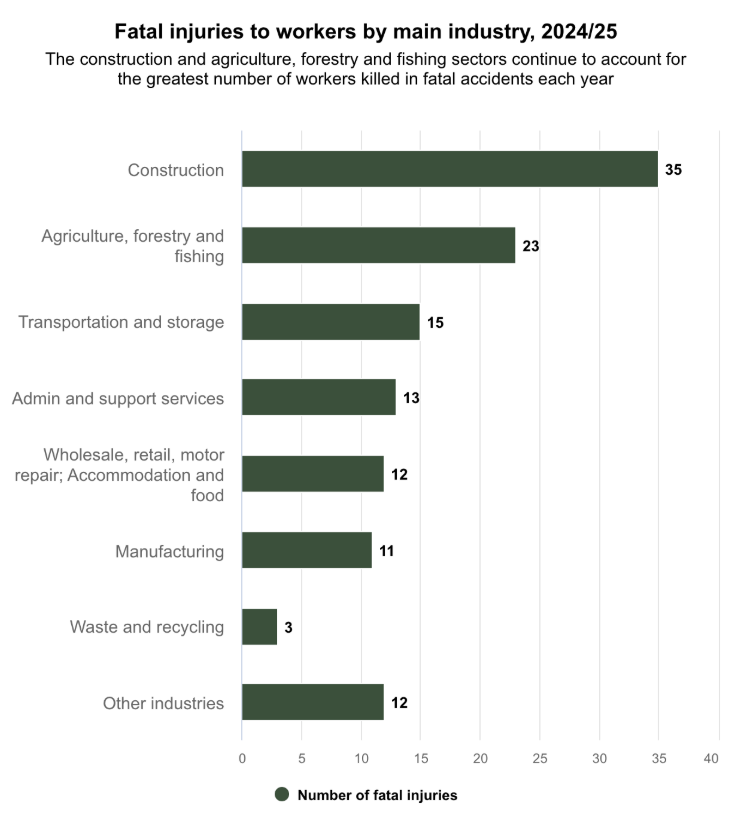
Construction remains one of the most dangerous industries in the UK. According to Health and Safety Executive’s 2025 survey, in 2024/25, construction recorded 35 worker fatalities — signficantly more than any other sector.
But the more important detail is how those deaths happen.
As HSE’s Fatal Injury data shows, falls from height remain the leading cause of workplace death, accounting for 36% of all worker fatalities last year.
That matters because scaffolding sits directly inside that risk. When people fall on job sites, they’re often working at height. They’re often using access systems. They’re often standing on scaffolding.
This is why scaffolding compliance carries weight. It is not peripheral. It is central.
And it is not only about fatalities.
When someone’s injured, the impact spreads. Work pauses. Investigations begin. Statements are taken. Insurance is notified. Programmes slip.
As HSE shows, an estimated 40.1 million working days were lost due to work-related ill health and injury in 2024/25.
Those lost days mean lost productivity. And lost productivity means cost.
But it’s not just about injuries or financial losses. It’s the repercussions from non-compliance that really bite you.
Regulators are no longer as passive as they used to be. In 2024/25, HSE prosecuted 298 cases and secured convictions in 93% of them.
When standards fall short, enforcement follows. And responsibility does not stop with the scaffolder. It moves regulatory exposure up the supply chain to the principal contractor — you.
Rather than leaving yourself open to liability, you need to build strong compliance. That’s how you control risk before it controls you.
The regulations that govern scaffolding in the UK
Scaffolding sits inside a web of overlapping regulations. Each element exists for a reason, and together, they shape contractor compliance.
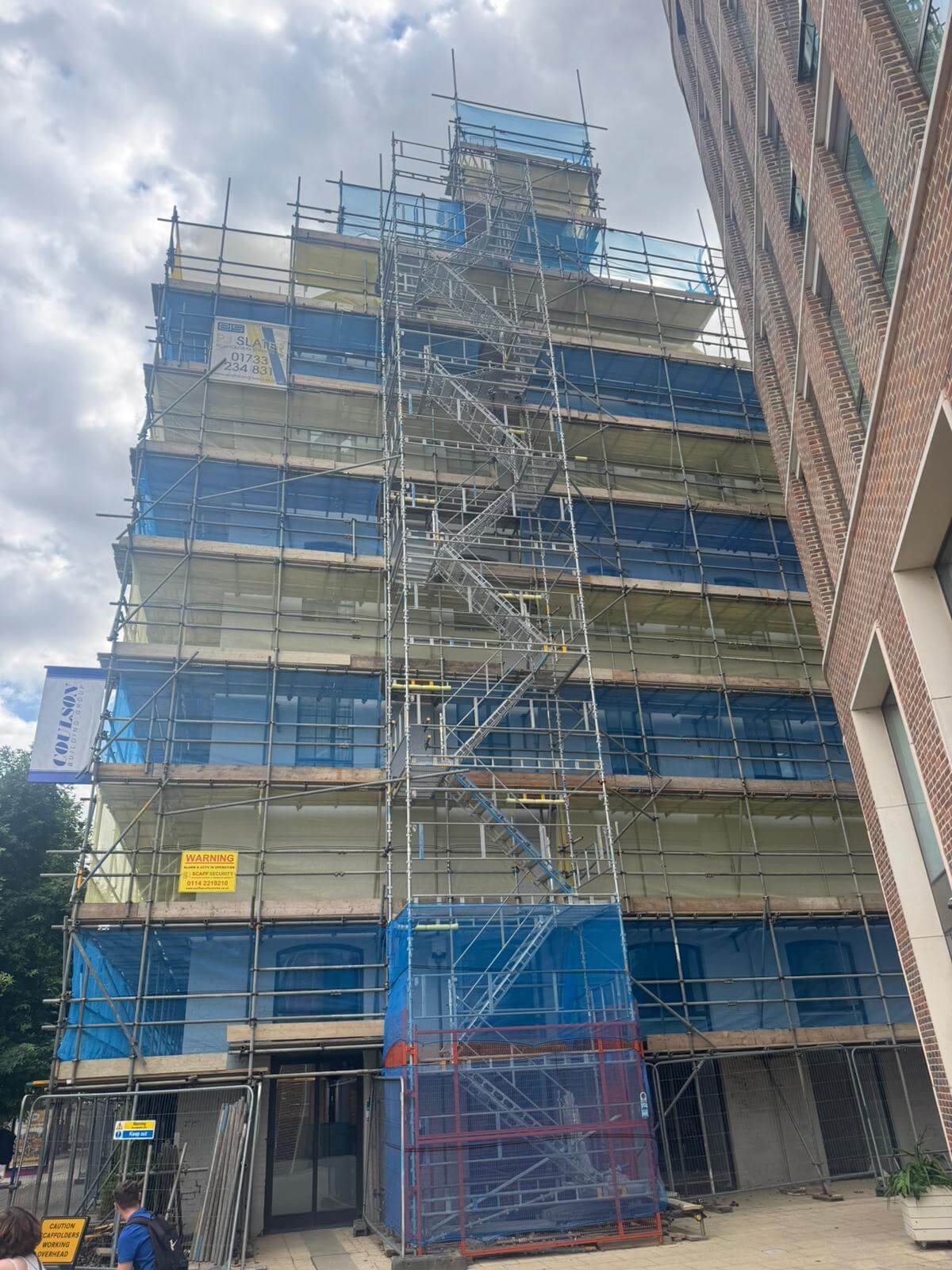
Working at Height Regulations
Working at Height regulations require work at height to be properly planned, supervised and carried out safely.
They establish the hierarchy of control:
- Avoid work at height where possible
- Prevent falls where it can’t be avoided
- Mitigate consequences if a fall occurs
They also require inspection at least every seven days and after significant alteration or adverse weather.
Commercially, this matters because failure to plan properly exposes contractors to direct enforcement action. It also disrupts your projects if someone falls and work has to stop.
TG20 Guidance
TG20 is the recognised benchmark for tube and fitting scaffolding in the UK. It sets out what counts as a standard, compliant build and where you need a bespoke design.
In simple terms, if the scaffold fits within TG20 guidance, you can evidence compliance. If it doesn’t, you need a proper, customised design in place.
Where problems arise is when a scaffold sits outside those limits, and no design has been commissioned.
It might look fine. It might stand up. But it is not compliant.
And when that happens, the risk does not sit neatly with the scaffolder. It moves up the chain. It becomes your exposure. You’re now non-compliant.
Ultimately, a technical shortcut on site can quickly turn into a legal problem off site. That is why structured firms build compliance workflows around design decisions rather than relying on assumption.
CISRS Certification
CISRS certification is how competence is evidenced in scaffolding.
It shows that the people building and supervising the structure have completed recognised training and passed an assessment. Different card levels reflect different responsibilities, from labourer to advanced scaffolder to supervisor.
That matters more than it sounds.
If the workforce is not properly CISRS-qualified, mistakes become more likely. Fixings are missed. Load assumptions are wrong. Supervision is thin.
And if something goes wrong, the first question will be simple. Were the operatives competent?
If you cannot evidence that, your position weakens immediately.
Scaffold Inspections
Scaffold inspections are where compliance becomes visible.
A compliant scaffolder issues a formal handover certificate before you ever use the scaffold. After that, inspections occur at legally defined intervals and after events such as severe weather.
You must retain the records of these inspections. That documentation forms part of your audit-ready evidence practices, creating a defensible record if scrutiny increases. If an inspection cannot be evidenced, in regulatory terms, it didn’t happen.
Building Safety Act
The Building Safety Act received Royal Assent on 28 April 2022, introducing a new Building Safety Regulator and stronger accountability for higher-risk buildings.
But here’s the change. The Building Safety Regulator now operates under a formal strategic plan for 2023–2026 focused on stronger oversight and enforcement.
This represents a shift in tone.
Accountability is clearer. Oversight is more structured.
On higher-risk buildings, gateways require more rigorous control. Scaffolding that interfaces with those projects must be part of that compliance structure.
CDM 2015
Under CDM 2015, construction work must be planned, managed and monitored so it is carried out safely.
The principal contractor coordinates. Other contractors must cooperate and provide information. Under CDM, each of them is a legal duty holder with clear responsibilities for site safety.
Here’s how scaffolding fits into this.
Scaffolding does not sit on its own. It interacts with roofing, cladding, mechanical works, façade access and demolition. If coordination fails, risk multiplies.
So when you don’t integrate scaffolding into your wider safety planning, any failures affect the whole project.
And under CDM, responsibility is shared — that means exposure is shared.
How to tell if a scaffolding company is truly compliant
Scaffolding compliance reveals itself in how a company answers simple questions.
Here’s what you need to ask:
- How often do you inspect, and what triggers additional checks?
- Do you issue formal handover certificates before use?
- Where’s your evidence of CISRS certification for operatives and supervisors?
- What scaffolding safety certifications do you carry?
- Do you work within TG20 parameters and commission bespoke designs when required?
- Are risk assessments and method statements provided proactively, not only when chased?
- How do you understand their responsibilities under CDM 2015?
- What happens after high winds or structural alteration?
If they can’t answer any of these questions clearly, that’s a red flag.
What happens if you choose a non-compliant scaffolder?
Non-compliance rarely announces itself loudly.
It starts small:
- An inspection missed
- A handover unsigned
- A design assumption was never formally checked
Then something happens. When that gap surfaces, the consequences move fast.
HSE can issue improvement notices or prohibition notices. Work stops. Access is restricted. Your programme stalls while evidence is gathered and corrections are made.
If the breach is serious, prosecution follows. In 2024/25, HSE secured convictions in 93% of prosecuted cases. That means fines are not unusual.
In serious cases, directors and senior managers can face personal liability and even custodial sentences.
This is not abstract regulation. It is financial exposure.
Fines can reach into the hundreds of thousands, sometimes more, depending on company turnover and severity. Legal fees accumulate. Senior time is diverted into interviews and documentation reviews.
Insurance providers then reassess risk. Public Liability Insurance and employers’ liability cover come under scrutiny. Premiums can rise. Excesses can increase. Renewal becomes more difficult.
And the impact doesn’t stop there.
Prequalification under schemes such as the Veriforce CHAS standard or the Common Assessment Standard can be affected. Tender opportunities narrow. Your reputation within the supply chain shifts quietly.
And when enforcement follows, responsibility doesn’t sit neatly with the subcontractor. It reaches the principal contractor. It reaches the client. It reaches those defined as duty holders under CDM.
The scaffold may have been erected by someone else. But the buck stops with you.
Why compliance is a commercial advantage — not just a legal requirement
Compliance is often treated as a defensive measure. Something you do to avoid trouble.
In reality, structured contractor compliance improves how a project runs. It reduces friction. It removes uncertainty. It makes performance more predictable. It becomes part of your wider risk management solutions, reducing uncertainty across your projects.
When you manage your scaffolders properly, it stops being a risk variable and starts becoming part of your operational stability.
Here’s what that looks like in practice:
- Reduced inspection delays: When handovers, designs and inspection records are in place, site inspections move faster. There is less disruption and fewer reactive fixes.
- Stronger planning coordination: A compliant scaffolder works within programme constraints, flags structural or load limitations early and coordinates with other trades before issues escalate.
- Protected programme certainty: Fewer compliance gaps mean fewer unexpected stoppages, fewer enforcement surprises and fewer last-minute redesigns.
- Smoother audits and prequalification: Clear documentation creates a reliable audit trail. This supports reviews under CHAS, the Common Assessment Standard and other safety schemes.
- Improved supply chain reputation: Contractors known for structured compliance are viewed as lower risk. Clients increasingly look for contractors who contribute to safer workplaces, not just those who meet minimum standards. That strengthens client relationships and supports repeat work.
Compliance, done properly, is not a drag on performance. It’s what allows performance to hold under pressure.
How PJS Approaches Compliance in Practice
Compliance doesn’t happen by accident. It happens when scaffolding firms treat it as an operating system, not an add-on.
At PJS, compliance begins with people, and then it shows up in every process that follows.
As a highly-competant scaffolding company with 40+ years of experience, we do things in a way that anticipates questions before they’re asked.
Here’s why contractors choose PJ Slater as their committed compliance-first scaffolder:
- Competent, CISRS-trained workforce: Our teams hold the appropriate training and certification for the task at hand. When operatives and supervisors are trained to recognised standards, errors are less likely, and decisions on site are more confident. Ultimately, a well-trained contractor workforce is the foundation of consistent compliance
- TG20 compliance and design where required: Where a standard configuration fits, we work within established TG20 guidance. Where it doesn’t, we commission bespoke design. That means the structure is safe the first time, and the reasoning behind it can be documented and justified.
- Formal handovers before use: Before any scaffold is signed off for use, it is formally handed over with certificates and clear communication to the client or site lead. There are no assumptions.
- Structured inspections on schedule and after events: Inspections are not occasional. They follow a documented regime — weekly, after alteration, and after adverse weather. Each check is recorded, creating a reliable audit trail that supports your own contractor compliance checks.
- Clear communication with principal contractors and their onsite contractors: We don’t install in isolation. We coordinate with the principal contractor, trades on site, and project planners so that scaffold access aligns with wider site safety planning.
- Documentation issued on time: Risk assessments, method statements, inspection records and handover paperwork are issued promptly. This isn’t “after the fact” administration — it’s proactive compliance support.
- Integration into project planning: Scaffolding is part of the project, not an add-on. Conversations about sequence, risk, access and interface happen early, so scaffolding doesn’t become a bottleneck later.
Ready to partner with compliance-first scaffolder? Choose PJ Slater.
If you’re a contractor, certainty matters. If you need a scaffolder who understands Contractor Compliance properly, choose PJ Slater. When you work with us, projects run with fewer surprises, inspections move faster, and risk stays controlled.
Contractors across Cambridgeshire, Lincolnshire, Bedfordshire, and Leicestershire trust us because we deliver structured compliance, consistent standards and dependable service on every site.
We don’t treat scaffolding as basic access. We treat it as part of your wider project responsibility.
Use our enquiry form for a free, no-obligation quote or call us to discuss your project.
📞 01733 234 831
📧 info@pjsscaffold.co.uk
📝Fill in the enquiry form opposite
Looking for compliance-readr scaffolding? We also serve clients in Cambridgeshire, Peterborough, Lincolnshire, Rutland, Leicestershire, Northamptonshire, and Bedfordshire. Got any questions? Contact us or check out our scaffolding FAQs.


